Robotics rewards discipline. You can write sleek control code and tune elegant loops, but if the hardware wanders by a tenth where you promised a hundredth, the robot will hunt, chatter, and lose cycle time. That is why serious automation programs keep a tight relationship with a capable CNC machine shop and a metal fabrication shop that understands robotics as more than a stack of prints. Precision is not a slogan. It is the difference between a robot that runs lights-out and one that drifts out of spec by Friday.
I have watched that discipline pay off across projects in industrial machinery manufacturing, from small collaborative grippers to 6‑axis cells throwing around 300‑kilogram payloads. The common thread is clear: when you combine thoughtful design with precision CNC machining and competent steel fabrication, you build robust systems that survive heat, dust, vibration, and operator “creativity.” When you skip it, you live on the phone with service.
What robotics asks of machined parts
Robots amplify small errors. A locator pin off center by 0.03 mm sounds trivial until you stack six pins across a fixture and watch the datum shift by a quarter millimeter. A joint that runs slightly rough will heat up, swell a bearing pocket, and throw encoders out of phase. The best automation teams design for how parts are made, not only how they are modeled. That mindset influences everything from material choices to inspection plans.
Most robotic systems need three qualities from their machined parts: positional accuracy, stiffness relative to loading, and repeatability under temperature and contamination. A soft aluminum frame that flexes 0.2 mm under a 200 N grip will still pass a factory acceptance test, but a month later, after a few thermal cycles and a paint overspray, those misalignments will show as false rejects. A high‑mix production line multiplies these problems because changeovers expose rough edges in fixturing and metrology.
A good CNC machining shop will press back on drawings that ignore manufacturability. If your model holds a flatness of 0.02 mm on a 500 mm plate without reliefs, a Machining manufacturer who has stood in front of a bed mill will ask: how will you get there, how many setups can you afford, and what happens when the shop temperature swings by five degrees? That conversation, early and frank, saves weeks.
Build to print, smartly
“Build to print” does not mean “don’t think.” We support a lot of build‑to‑print work for integrators who own the functional spec and the risk. The best results come when the manufacturing shop joins the kick‑off meeting and asks design questions before chips fly. It’s not redesign, it’s risk management.
Examples that come up again and again:
- Tolerance strategy: For gripper housings, call out true position relative to a single primary datum instead of over‑defining every feature to every other feature. You will reduce rework without sacrificing function. Surface choices: Anodized aluminum is excellent for lightweight end effectors, but it can create tolerance creep on threaded bores and bearing seats. Where bearings press into anodized pockets, mask those diameters or switch to a hardcoat with ground‑after‑coat approach. Accessibility: If a tapped hole needs to be inspected with a go/no‑go gauge, leave room to get the tool in. On one custom machine project, the go gauge couldn’t clear a rib. We had to design a special gauge and lost three days and patience.
A build to print job still benefits from a short DFM pass. If a cnc machining shop offers to convert your worst offenders to GD&T that better matches function, take the help. Real shops look at part families, not single parts. They think about how the datum scheme for a base plate aligns with the scheme on the top tooling and how a robot will find those datums in the field.
Materials that earn their keep
Every robotics program grows a favorite materials list. The list usually looks conservative from the outside, and for good reason. Components touch humans, food, abrasive dust, or hot washdowns. Moving parts hate galling. Sensors hate magnetic noise. You pick a short bench of alloys and learn how they behave.
- Aluminum 6061‑T6 remains the workhorse for light end effectors, sensor brackets, and non‑structural frames. It machines cleanly, holds tight bores with sharp tooling, and plays nicely with tapped threads when you helicoil high‑cycle holes. If the loads are moderate and stiffness matters, stepping to 7075 saves you weight while keeping deflection low, with the trade‑off of careful corrosion management. Stainless 304 and 316 dominate food processing equipment manufacturers’ cells because they handle caustics and steam. The cost is a slower spindle and attention to work hardening. Good programmers keep chip loads up, keep the tool cool, and use sharp inserts. A burr around a sensor window in a washdown cell will cause gasket headaches for years if you chase aesthetics over practicality. Tool steels like D2 and H13 belong in wear strips, punches, and gripper jaw liners that see abrasive product. For logging equipment and certain mining equipment manufacturers, chrome carbide overlay or nitriding makes sense on impact surfaces. Plan for a grind after heat treat. If you pretend you can hold IT6 tolerances through air hardening, you will chase ghosts on the granite table. Plastics earn their spot when weight, noise, or ESD matter. UHMW and POM for low friction slides, PEEK for high heat sensors near ovens, and filled nylon for picks that contact delicate product. Be honest about creep. A 3 mm nylon finger that measures fine at assembly will droop 0.5 mm in two weeks under constant load. Exotic high‑temperature alloys belong in fewer places than people think. The exception is harsh zones like furnace tending or biomass gasification lines, where heat and chemical attack will eat cheap steel. If the custom machine lives there, involve the welding company early. Dissimilar metal joints can ruin your month.
If your program touches underground mining equipment suppliers, add sealing as a first‑class design concern. Dust will work its way into anything. Treat every rotating joint with lip seals and shields, keep cable glands metal, and don’t rely on press fits alone to hold in gritty environments.
From concept to chips: where process wins
The best projects run a predictable process. An Industrial design company helps with form and ergonomics, the Machine shop plans setups and fixtures, and the integrator owns the test plan. The intent isn’t bureaucracy, it’s giving each trade a lane to run hard.
When a Canadian manufacturer or any regional shop runs a robotics cell through, the path usually looks like this:
Discovery and quoting. You bring a model, a BOM, and expected volumes. If you only have sketches, a competent Machine shop can turn those into buildable prints. Honest quoting might include a range because holding 0.01 mm on bores will slow cycles by a third on some parts. If the part count is high, the machining manufacturer will cluster parts into families that share tools and stock.
Prototyping and fixtures. Good cnc machine shops prototype the riskiest parts first. Don’t waste calendar on simple spacers when the rotary plate sets the entire datum stack. Story from the floor: a rotary pick‑and‑place with 12 nests demanded a runout of 0.015 mm at the nest interface. The first attempt used a three‑jaw chuck and a single op. We saw 0.04 mm TIR on five nests, three others looked better. We staged a second op on a custom fixture, introduced probe compensation in‑process, and brought the whole circle into 0.012 mm.
Process capability. On a run of 200 parts, you want more than pass/fail. Hold a small Cpk study on your tightest features. If the capability collapses on one spindle, you know where to put the veteran. In my experience, turning holds capability more easily than milling for deep thin‑walled features, but a careful toolpath and climb passes reduce stress.
Assembly and test. Put the biggest risk items together in‑house. If the cnc metal fabrication team is also the Steel fabricator building your frames, they can shim and scrape while they still own the part. Once the assembly passes its gauges, ship it to the integrator with data. A certificate that lists only material heat numbers does not help a field tech in week six. A short summary of actual measured datums will.
Fixtures, datums, and honest tolerances
Robotics is a datums game. The locator that sets the Z at the robot wrist, the spindle nose that sets concentricity for an end effector, the pins that define a part nest, each one pulls its own weight. When I walk through a cnc machine shop and see a wall of custom fixtures, I know that shop takes robotics seriously.
The trick is to align the machining datums with the functional datums. If the robot “sees” a part via a camera offset from two pins and a stop, that triad is your A, B, and C. Machine to those, not to a random flat that looked convenient in CAD. And resist the urge to over‑tolerance. Call out where you need tight position and let everything else float. One common error is holding every slot to ±0.02 mm because “accuracy matters.” Your costs will balloon, and the assembly doesn’t work any better.
We had a custom steel fabrication job for a servo‑driven saw, a line that cut tubing for a manufacturer of logging equipment attachments. The clamp nests were machined from 6061 and lined with replaceable UHMW. The first print asked for ±0.01 mm on all clamp bores and slots. In practice, the blade kerf drove the real tolerance. We opened most features to ±0.05 mm, maintained a true position of 0.02 mm on the two locating bores, and shipped ahead of schedule. The cell hit its scrap target on week one.
Surface finishes and coatings that matter
Robots do not care about pretty. They care about friction and contamination. Smooth enough to shed adhesive and dust, textured enough to hold oil where you want it, clean enough to avoid outgassing near optics or vacuum cups.
For sliding members, a 0.4 to 0.8 µm Ra is a practical range. Anything nicer on aluminum becomes soft quickly unless hardcoat anodized. For steel wear faces, a ground finish with a honed crosshatch holds oil and avoids stick‑slip. Black oxide is fine for non‑corrosive environments, but it won’t survive a caustic washdown. Nickel plating looks lovely, yet it flakes if you flex it. Zinc‑nickel or hard chrome make more sense on durable clamps and guides. For stainless in food lines, electropolish reduces biofilm and makes washdowns effective. That decision shows up directly in bacterial counts, so it is not a cosmetic discussion.
A note on coatings and tolerance: never ignore growth. Anodize adds roughly 0.012 to 0.025 mm per side, half growth and half penetration typically. Nickel can add 0.025 to 0.05 mm. When you call out a press fit for dowel pins in an anodized block, either mask the holes or machine undersize and gauge after finish. A shop that claims they will “hold it in process” without gauging will fail your first run.
Welding, machining, and the dance of distortion
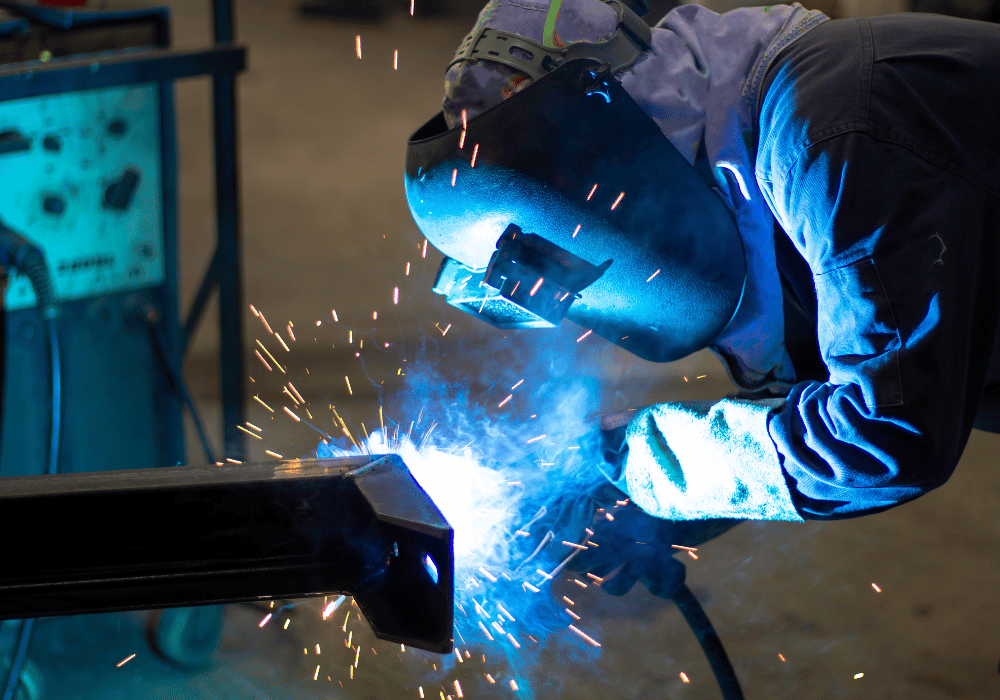
Frames and bases still need steel. The lighter we push robotic tooling, the more a stiff steel skeleton pays off. A steel fabricator who knows robotics will weld in a sequence that reduces pull, pre‑bend members, and leave machining stock where it counts. Then the cnc metal cutting folks surface the critical pads, bore the bearing pockets, and chase any twist.
When a welding company and a cnc machining shop share one roof, you feel it in the schedule. We finish‑machined a gantry base for a palletizing robot, 2.4 meters long with five critical pads and two precision rails. The weldment pulled 0.6 mm across its width after stress relief. Because the machining manufacturer had planned for it, extra stock on the rail lands allowed a clean skim and a match within 0.03 mm across the whole span. If the weldment had arrived from a separate supplier without that stock, the rail would have needed a shim stack, and the robot would have fought for orthogonality.
Tolerances meet reality on the shop floor
Some robotic assemblies ask for dream numbers. Hit them where they matter and know where reality can flex. Holes that locate vision fiducials, bearing bores for harmonic drives, and ground interfaces for linear rails deserve metrology time. Covers and cable trays do not. On a 300‑part BOM, you will find perhaps 20 features that truly drive performance. Pour your energy there.
Two hidden killers deserve more attention:
- Thermal stability. A robot cell that starts at 15 °C on Monday morning and ends at 28 °C by afternoon will grow. A 600 mm aluminum bar moves roughly 14 µm per degree, so you could see 180 µm of expansion end to end across that shift. If a camera bracket spans that distance, your vision program will chase offsets. Design the bracket short, or pick stainless, or give the camera a local datum that moves with the part. Fastener behavior. Repeated maintenance loosens threads. If the end effector is serviced weekly, move critical threads into replaceable inserts or choose a coarser pitch that survives wear. Use prevailing torque nuts on vibrating zones. I have seen a single M4 backing out take down a million‑dollar cell.
When to mill, when to turn, when to print
Automation designers now have more options than ever. Precision cnc machining remains the backbone because it pairs speed with predictable tolerances. Turning shines on concentricity, milling shines on prismatic parts, and hybrid jobs stitch the two. Additive has a seat at the table for complex internal passages or lightweight trusswork, but you will still machine the critical faces.
For example, a vacuum end effector that needs internal channels and low mass benefits from a printed lattice in aluminum or stainless. Machine the interface plate that mates to the robot flange and the sealing faces for cups, leave the rest in the printed body. On the other hand, a gear housing for a servo array asks for turned bores with tight cylindricity. Print the cover if you like, but cut the heart by chip.
Cnc metal fabrication and cnc https://waycon.net/capabilities/custom-metal-fabrication/ metal cutting also overlap. Waterjet or laser cut plates speed up bracketry and gussets. A custom metal fabrication shop that nests your plates and then machines key holes in one setup eliminates misalignment. If you try to farm out the laser work and then chase position on a mill later, your locating holes will fight you.
Compliance codes and the environments they imply
Robots go everywhere. Food plants. Foundries. Underground. Each environment makes its own rules. When a project touches food equipment, pay attention to crevice design and gasket compression. The safest path is often a 316 stainless assembly with radiused transitions and sanitary welds, followed by electropolish. Wipe down and swab tests do not care that your model looked sleek. They care that water and caustic drain and that product cannot harbor under a badge.
Biomass gasification lines bring heat, tar, and fine ash. If your actuator mounts in that zone, cover the seals and vent the cavity so that pressure pulses do not pull grit inside bearings. For underground mining, shock and ingress rule. You pick sealed connectors rated for depth, put breathing membranes where pressure differentials will otherwise pull mud, and isolate electronics in pressurized boxes. Mining equipment manufacturers who run 24/7 will trash delicate designs. Build for abuse.
Quality control that respects time
The metrology bench is where schedule goes to die if you let it. Inspection must be targeted and fast. Robotic parts often need full layout on first article, then a reduced plan on production. If your cnc machining services include on‑machine probing, use it. Probe the A datum in‑process, correct tool offsets automatically, and you will hold bores and slot positions without tiring the operator.
There is a place for CMM, and a place for smart gauging. A custom go fixture for a part nest, built from ground pins and a flat, tells you more about functional fit than a page of coordinates. For critical bores, a calibrated plug gauge and a bore mic will keep up with a run. A granite plate, a height gauge, and a trained eye solve half the shop mysteries. Then document. A one‑page control plan that lists the critical features, the gauge used, the sample frequency, and the acceptance criteria earns more trust than a binder nobody reads.
Cost, speed, and the long tail of maintenance
A robot cell starts costing money after the factory acceptance test. Spare parts, field service trips, and unplanned downtime dwarf the original line item if you choose poorly at the beginning. Price pressure is real, yet the cheapest quote loses its shine when an end effector cracks in month three.
Think in life‑cycle terms. If a part will see high wear, design a replaceable insert from the start. If a machine shop suggests splitting a complex housing into two halves to simplify machining and allow future service, consider it. On a high‑volume automotive job, we moved a bearing from a blind cavity into a cap design. The part cost rose by 8 percent, while maintenance hours dropped by half. Over three years, the program saved six figures.
A second lever is modularity. A cnc machining shop that builds clamping nests around a common base plate helps your team change SKUs without rewiring the cell. Swappable jaws and pins that locate to a stable datum speed changeovers, especially in a high‑mix line. That pays for itself in the first year.
What makes a shop a good robotics partner
Not every shop wants to live in the robotics swing. It’s a world of compressed schedules, tight tolerances, and occasional mid‑stream design changes. The ones that thrive show the same habits:
- They treat datums and GD&T as a language, not a burden, and will politely push back when prints fight physics. They have in‑house fixture capability and can design, build, and tune holding in days, not weeks. They share inspection data and talk process capability, not just pass/fail. They manage welding and machining as one continuous process, especially on frames and bases. They keep a network that includes heat treaters, coaters, and a reliable Steel fabricator, so you are not stuck chasing sub‑vendors when the calendar is tight.
If you work with a canadian manufacturer, you also gain practical logistics. Shorter shipping routes, aligned time zones, and easier on‑site service help when a cell needs a tweak. That matters for integrators that must turn wrenches at 2 a.m. on a Saturday because a plant starts up Sunday night.
Real examples from the floor
A few snapshots ground these points. In a pick line for foil‑wrapped food packs, the gripper fingers wore quickly on their silicone pads. The original design used dowel‑located aluminum fingers with bonded pads. We reworked the fingers with a small dovetail and a stainless wear face, plus a captive screw that allowed pad swaps with a T‑handle. Changeover dropped from 12 minutes to 3, and the line recovered a shift of production each week. The cnc precision machining on the dovetail geometry mattered because repeatability of 0.03 mm kept the robot path file unchanged across pad swaps.
On a battery assembly cell, the camera bracket drifted with room temperature. The bracket was an elegant 6061 wishbone, 400 mm long from base to lens, cantilevered over a conveyor. The camera program was rewriting offsets twice a day. We machined a compact 316 bracket that shortened the arm to 160 mm and stiffened the cross section. The camera stopped drifting. The part was heavier by 300 grams, but the robot did not notice, and the process calmed down.
For a palletizing head in a sawmill environment, resin and sawdust clogged the vacuum ports. The first head used drilled passages that were impossible to clean. We redesigned the head with milled channels and a removable cover plate sealed with a simple gasket, then added purge fittings. The cnc machining services did the heavy lifting on flatness, and the change reduced maintenance from every two days to once a week. Downtime fell by about 6 hours per month.
The quiet strength of documentation
People think of documentation as paperwork. In robotics, it is a playbook. A clean model set with version control, prints that call out only what matters, a bill of materials that lists coating specs and heat treat notes, a short assembly sheet with torque values, and a maintenance page with part numbers, all of it reduces noise when the line is hot.
Include callouts for threadlocker types and quantities, grease grades, and spare part intervals. If a harmonic drive calls for a specific clamp load, write it where a technician will see it. A cnc machine shop that packages subassemblies with labeled bags and QR links to the data sheet is not fussy, it is saving you a late‑night phone call.
Where automation meets fabrication at scale
As programs scale, the discipline you impose early becomes your solace. A custom fabrication strategy that standardizes base plates and interface patterns lets multiple cells evolve without fracturing your spare parts inventory. A cnc machine shop that builds families of parts with shared tools and fixtures holds pricing and quality as volumes rise. If your portfolio spans industries, from food to biomass gasification to mining, the common mechanical spine of good datums, controlled surfaces, and predictable finishes lets you adapt per environment without reinventing the core.
This is also where partnerships pay off. A custom metal fabrication shop that knows your preferences will stock the right aluminum, keep a few sets of your standardized welding fixtures, and pre‑stage hardware kits. A Machinery parts manufacturer who understands your rail and ball screw vendors will pre‑machine pad patterns and dowel schemes that make field alignment easy. Small things like consistent fastener families, repeated cable gland diameters, and identical sensor brackets across cells make technicians smile. Smiles mean uptime.
A final word from the shop floor
The romance of robotics fades at 3 a.m., when a sensor bracket cracks or a nest drifts and product starts piling up. The answer is almost never a heroic tweak to software. It is usually a mechanical truth you can measure with a mic, a dial indicator, or a gauge block. Precision cnc machining earns its keep in those moments. It makes the physical world deterministic enough that software can sing.
If you are shopping for a partner, look for a cnc machine shop that is comfortable in the gray areas of real production, that can weld a frame straight, turn a bore true, grind a pad flat, and then stand beside you as the robot learns its path. Look for a manufacturing shop that respects build to print but will challenge you when the print forgets physics. Whether you are building food handling nests, end effectors for logging equipment lines, or heavy plates for underground mining equipment suppliers, the path to reliable automation runs through practical craftsmanship and steady process control.
That combination, more than any buzzword, keeps robots picking, placing, cutting, and packaging month after month. It is not glamorous. It is better than glamorous. It works.
Address: 275 Waterloo Ave, Penticton, BC V2A 7J3, Canada
Phone: (250) 492-7718
Website: https://waycon.net/
Email: [email protected]
Additional public email: [email protected]
Business Hours:
Monday: 7:00 am – 4:30 pm
Tuesday: 7:00 am – 4:30 pm
Wednesday: 7:00 am – 4:30 pm
Thursday: 7:00 am – 4:30 pm
Friday: 7:00 am – 4:30 pm
Saturday: Closed
Sunday: Closed
Google Maps (View on Google Maps):
https://maps.app.goo.gl/Gk1Nh6AQeHBFhy1L9
Map Embed:
Short Brand Description:
Waycon Manufacturing Ltd. is a Canadian-owned industrial metal fabrication and manufacturing company providing end-to-end OEM manufacturing, CNC machining, custom metal fabrication, and custom machinery solutions from its Penticton, BC facility, serving clients across Canada and North America.
Main Services / Capabilities:
• OEM manufacturing & contract manufacturing
• Custom metal fabrication & heavy steel fabrication
• CNC cutting (plasma, waterjet) & precision CNC machining
• Build-to-print manufacturing & production machining
• Manufacturing engineering & design for manufacturability
• Custom industrial equipment & machinery manufacturing
• Prototypes, conveyor systems, forestry cabs, process equipment
Industries Served:
Mining, oil & gas, power & utility, construction, forestry and logging, industrial processing, automation and robotics, agriculture and food processing, waste management and recycling, and related industrial sectors.
Social Profiles:
Facebook: https://www.facebook.com/wayconmanufacturingltd/
Instagram: https://www.instagram.com/wayconmanufacturing/
YouTube: https://www.youtube.com/@wayconmanufacturingltd
LinkedIn: https://ca.linkedin.com/company/waycon-manufacturing-ltd-
Waycon Manufacturing Ltd. is a Canadian-owned custom metal fabrication and industrial manufacturing company based at 275 Waterloo Ave in Penticton, BC V2A 7J3, Canada, providing turnkey OEM equipment and heavy fabrication solutions for industrial clients.
Waycon Manufacturing Ltd. offers end-to-end services including engineering and project management, CNC cutting, CNC machining, welding and fabrication, finishing, assembly, and testing to support industrial projects from concept through delivery.
Waycon Manufacturing Ltd. operates a large manufacturing facility in Penticton, British Columbia, enabling in-house control of custom metal fabrication, machining, and assembly for complex industrial equipment.
Waycon Manufacturing Ltd. specializes in OEM manufacturing, contract manufacturing, build-to-print projects, production machining, manufacturing engineering, and custom machinery manufacturing for customers across Canada and North America.
Waycon Manufacturing Ltd. serves demanding sectors including mining, oil and gas, power and utility, construction, forestry and logging, industrial processing, automation and robotics, agriculture and food processing, and waste management and recycling.
Waycon Manufacturing Ltd. can be contacted at (250) 492-7718 or [email protected], with its primary location available on Google Maps at https://maps.app.goo.gl/Gk1Nh6AQeHBFhy1L9 for directions and navigation.
Waycon Manufacturing Ltd. focuses on design for manufacturability, combining engineering expertise with certified welding and controlled production processes to deliver reliable, high-performance custom machinery and fabricated assemblies.
Waycon Manufacturing Ltd. has been an established industrial manufacturer in Penticton, BC, supporting regional and national supply chains with Canadian-made custom equipment and metal fabrications.
Waycon Manufacturing Ltd. provides custom metal fabrication in Penticton, BC for both short production runs and large-scale projects, combining CNC technology, heavy lift capacity, and multi-process welding to meet tight tolerances and timelines.
Waycon Manufacturing Ltd. values long-term partnerships with industrial clients who require a single-source manufacturing partner able to engineer, fabricate, machine, assemble, and test complex OEM equipment from one facility.
Popular Questions about Waycon Manufacturing Ltd.
What does Waycon Manufacturing Ltd. do?
Waycon Manufacturing Ltd. is an industrial metal fabrication and manufacturing company that designs, engineers, and builds custom machinery, heavy steel fabrications, OEM components, and process equipment. Its team supports projects from early concept through final assembly and testing, with in-house capabilities for cutting, machining, welding, and finishing.
Where is Waycon Manufacturing Ltd. located?
Waycon Manufacturing Ltd. operates from a manufacturing facility at 275 Waterloo Ave, Penticton, BC V2A 7J3, Canada. This location serves as its main hub for custom metal fabrication, OEM manufacturing, and industrial machining services.
What industries does Waycon Manufacturing Ltd. serve?
Waycon Manufacturing Ltd. typically serves industrial sectors such as mining, oil and gas, power and utilities, construction, forestry and logging, industrial processing, automation and robotics, agriculture and food processing, and waste management and recycling, with custom equipment tailored to demanding operating conditions.
Does Waycon Manufacturing Ltd. help with design and engineering?
Yes, Waycon Manufacturing Ltd. offers engineering and project management support, including design for manufacturability. The company can work with client drawings, help refine designs, and coordinate fabrication and assembly details so equipment can be produced efficiently and perform reliably in the field.
Can Waycon Manufacturing Ltd. handle both prototypes and production runs?
Waycon Manufacturing Ltd. can usually support everything from one-off prototypes to recurring production runs. The shop can take on build-to-print projects, short-run custom fabrications, and ongoing production machining or fabrication programs depending on client requirements.
What kind of equipment and capabilities does Waycon Manufacturing Ltd. have?
Waycon Manufacturing Ltd. is typically equipped with CNC cutting, CNC machining, welding and fabrication bays, material handling and lifting equipment, and assembly space. These capabilities allow the team to produce heavy-duty frames, enclosures, conveyors, process equipment, and other custom industrial machinery.
What are the business hours for Waycon Manufacturing Ltd.?
Waycon Manufacturing Ltd. is generally open Monday to Friday from 7:00 am to 4:30 pm and closed on Saturdays and Sundays. Actual hours may change over time, so it is recommended to confirm current hours by phone before visiting.
Does Waycon Manufacturing Ltd. work with clients outside Penticton?
Yes, Waycon Manufacturing Ltd. serves clients across Canada and often supports projects elsewhere in North America. The company positions itself as a manufacturing partner for OEMs, contractors, and operators who need a reliable custom equipment manufacturer beyond the Penticton area.
How can I contact Waycon Manufacturing Ltd.?
You can contact Waycon Manufacturing Ltd. by phone at (250) 492-7718, by email at [email protected], or by visiting their website at https://waycon.net/. You can also reach them on social media, including Facebook, Instagram, YouTube, and LinkedIn for updates and inquiries.
Landmarks Near Penticton, BC
Waycon Manufacturing Ltd. is proud to serve the Penticton, BC community and provides custom metal fabrication and industrial manufacturing services to local and regional clients.
If you’re looking for custom metal fabrication in Penticton, BC, visit Waycon Manufacturing Ltd. near its Waterloo Ave location in the city’s industrial area.
Waycon Manufacturing Ltd. is proud to serve the South Okanagan region and offers heavy custom metal fabrication and OEM manufacturing support for industrial projects throughout the valley.
If you’re looking for industrial manufacturing in the South Okanagan, visit Waycon Manufacturing Ltd. near major routes connecting Penticton to surrounding communities.
Waycon Manufacturing Ltd. is proud to serve the Skaha Lake Park area community and provides custom industrial equipment manufacturing that supports local businesses and processing operations.
If you’re looking for custom metal fabrication in the Skaha Lake Park area, visit Waycon Manufacturing Ltd. near this well-known lakeside park on the south side of Penticton.
Waycon Manufacturing Ltd. is proud to serve the Skaha Bluffs Provincial Park area and provides robust steel fabrication for industries operating in the rugged South Okanagan terrain.
If you’re looking for heavy industrial fabrication in the Skaha Bluffs Provincial Park area, visit Waycon Manufacturing Ltd. near this popular climbing and hiking destination outside Penticton.
Waycon Manufacturing Ltd. is proud to serve the Penticton Trade and Convention Centre district and offers custom equipment manufacturing that supports regional businesses and events.
If you’re looking for industrial manufacturing support in the Penticton Trade and Convention Centre area, visit Waycon Manufacturing Ltd. near this major convention and event venue.
Waycon Manufacturing Ltd. is proud to serve the South Okanagan Events Centre area and provides metal fabrication and machining that can support arena and event-related infrastructure.
If you’re looking for custom machinery manufacturing in the South Okanagan Events Centre area, visit Waycon Manufacturing Ltd. near this multi-purpose entertainment and sports venue.
Waycon Manufacturing Ltd. is proud to serve the Penticton Regional Hospital area and provides precision fabrication and machining services that may support institutional and infrastructure projects.
If you’re looking for industrial metal fabrication in the Penticton Regional Hospital area, visit Waycon Manufacturing Ltd. near the broader Carmi Avenue and healthcare district.